

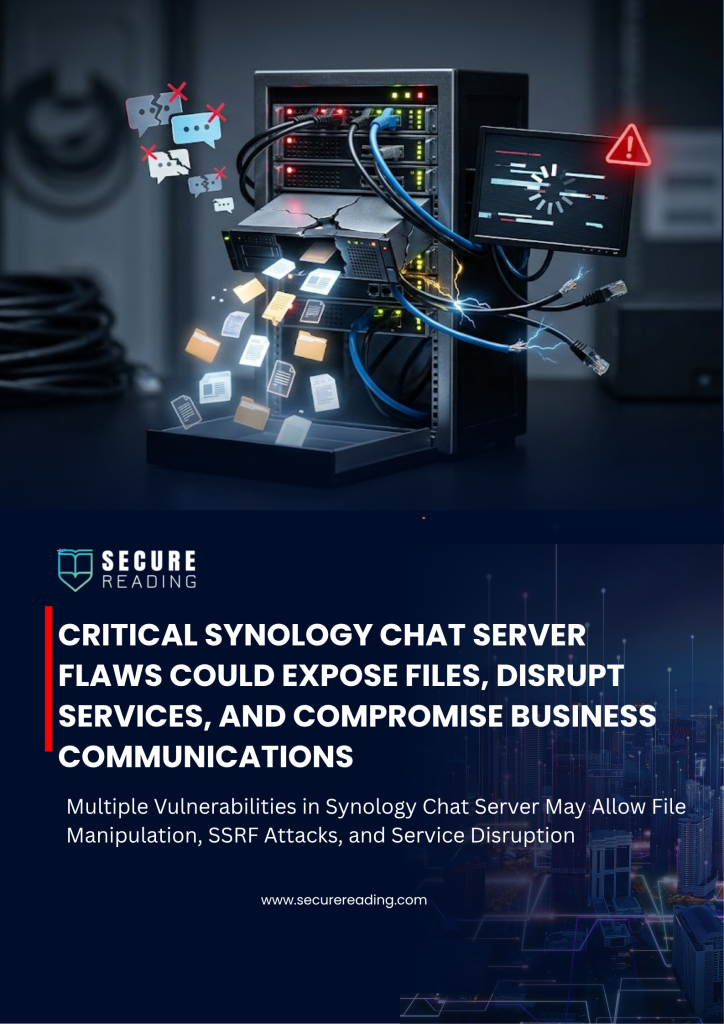
Multiple Vulnerabilities in Synology Chat Server May Allow File Manipulation, SSRF Attacks, and Service Disruption
By CyberShelter Threat Intel Team
Published: May 29, 2026
Severity: Critical
Highest CVSS Score: 9.0
Executive Summary
Critical Security Risks Identified in Synology Chat Server
Multiple security vulnerabilities have been discovered in Synology Chat Server, a widely used collaboration and enterprise messaging platform available for Synology DiskStation Manager (DSM).
The most severe flaw, tracked as CVE-2026-40541, carries a critical CVSS score of 9.0. Attackers with authenticated access could exploit this vulnerability to manipulate files, access restricted information, disrupt services, and potentially impact overall application integrity.
Additionally, researchers identified SSRF and cross-site scripting vulnerabilities that may expose internal systems, enable reconnaissance activity, and reduce service availability.
Because many organizations use Synology Chat Server for internal communications and collaboration workflows, successful exploitation could severely impact business operations and sensitive enterprise data.
Organizations should therefore prioritize immediate patch deployment and strengthen administrative access controls across all affected environments.
Technical Details
Vulnerability Breakdown
CVE-2026-40541 — Critical XSS Vulnerability
Attackers Could Manipulate Files and Disrupt Services
The most severe vulnerability affects the handling of user-controlled input within Synology Chat Server.
Successful exploitation may allow attackers to:
- Read arbitrary files
- Modify or overwrite files
- Trigger denial-of-service conditions
- Disrupt communication services
- Impact application integrity
- Access sensitive internal information
Furthermore, attackers may abuse compromised accounts to expand access within collaborative environments.
CVE-2026-9491 — Server-Side Request Forgery (SSRF)
Internal Network Exposure and Reconnaissance Risks
The SSRF vulnerability could allow attackers to force the server into making unauthorized internal requests.
As a result, attackers may:
- Conduct internal network reconnaissance
- Access internal resources
- Expose configuration details
- Gather sensitive environment information
Moreover, SSRF flaws often become stepping stones for larger infrastructure attacks when organizations expose services to the internet.
CVE-2026-9548 — Additional XSS Vulnerability
Secondary Cross-Site Scripting Weakness Increases Exposure
Researchers also identified another cross-site scripting vulnerability that could allow unauthorized access to restricted content and limited disruption of system functionality.
Potential impact includes:
- Unauthorized file access
- Data manipulation
- Reduced service availability
- Session abuse
- Limited operational disruption
Although this flaw carries a lower severity rating, attackers could still combine it with other weaknesses to increase overall impact.
Affected Products
Vulnerable Versions
The following Synology Chat Server versions are affected:
- Synology Chat Server for DSM 7.2.1
- Synology Chat Server for DSM 7.2.2
- Synology Chat Server for DSM 7.3
Patched Version
Organizations should immediately upgrade to:
Synology Chat Server 2.4.5-22148 or later
Risk Assessment
Potential Organizational Impact
Successful exploitation could allow attackers to:
- Read sensitive files
- Modify business data
- Disrupt communications
- Conduct denial-of-service attacks
- Expose restricted information
- Impact operational availability
In addition, organizations operating internet-accessible DSM environments may face elevated exposure to targeted attacks.
Large enterprises with multiple collaboration users may also experience broader operational impact if attackers compromise messaging infrastructure.
Recommended Actions
Immediate Mitigation Steps
01 — Update Immediately
Upgrade all affected Synology Chat Server deployments to version 2.4.5-22148 or later without delay.
02 — Restrict Administrative Access
Limit DSM and Chat Server administrative access to trusted users, internal networks, and secured VPN connections only.
03 — Strengthen Authentication Controls
Enable multi-factor authentication (MFA), enforce strong password policies, and regularly review role-based access controls (RBAC).
04 — Monitor System Activity
Review logs for:
- Unauthorized file access
- Unexpected service interruptions
- Suspicious login attempts
- Unusual user activity
- Configuration changes
05 — Conduct Security Assessments
Perform vulnerability scans, validate successful patch deployment, and review all internet-facing services for unnecessary exposure.
Strategic Security Perspective
Collaboration Platforms Continue to Attract Threat Actors
Messaging and collaboration platforms often contain highly sensitive organizational information, making them attractive targets for attackers.
Furthermore, modern collaboration systems frequently integrate with authentication platforms, file storage systems, and internal workflows. Consequently, a successful compromise may provide attackers with broader access across enterprise environments.
Organizations should therefore adopt a layered security approach that combines:
- Rapid patch management
- Strong authentication
- Network segmentation
- Continuous monitoring
- Least-privilege access controls
- Regular security assessments
Ultimately, securing collaboration infrastructure is essential for protecting operational continuity, confidential communications, and enterprise resilience.