

Social media messages are emerging as a stealthy entry point for malware and remote access attacks
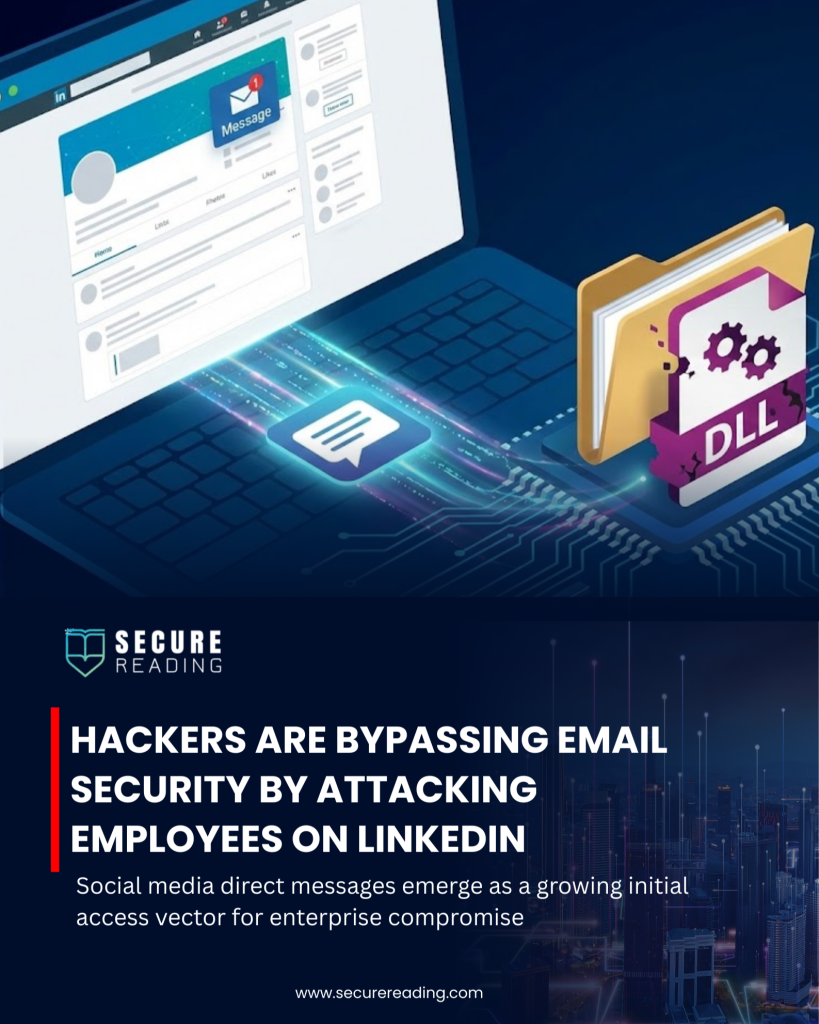
Cybersecurity researchers have uncovered a phishing campaign that uses private messages on social media to deliver malware. Instead of emails, attackers now contact targets directly on LinkedIn to bypass traditional security controls.
Researchers from ReliaQuest observed threat actors approaching high-value individuals through LinkedIn messages. The attackers build trust first. They then trick victims into downloading a malicious archive.
How the Attack Unfolds
The attackers send a convincing message and ask the victim to download a WinRAR self-extracting archive (SFX). Once the victim opens the file, the malware chain starts immediately.
The archive drops four components:
- A legitimate open-source PDF reader
- A malicious DLL loaded by the PDF reader
- A portable Python interpreter
- A decoy RAR file
When the user opens the PDF reader, it loads the malicious DLL. This technique, known as DLL side-loading, allows attackers to hide inside trusted applications.
Stealthy Execution and Persistence
The malicious DLL deploys the Python interpreter and creates a Windows Registry Run key. This step ensures the malware runs every time the user logs in.
Next, the Python component decodes and executes shellcode directly in memory. This approach avoids writing files to disk and limits forensic traces.
The final payload connects to an external server. Attackers then gain persistent remote access and begin data exfiltration.
Why This Technique Works
Attackers increasingly rely on DLL side-loading because it blends malicious activity with legitimate software. Security tools often struggle to detect this behavior.
Social media messages make the attack even more effective. Most organizations monitor email closely, but they rarely inspect LinkedIn messages. This gap gives attackers a clear advantage.
A Growing Pattern
Researchers have observed multiple recent campaigns using the same approach. Malware families such as LOTUSLITE and PDFSIDER now rely on DLL side-loading and social engineering.
Because these attacks happen in private messages, measuring their scale remains difficult. Many infections likely go unnoticed.
What This Means for Organizations
Social media platforms now act as unmonitored entry points into corporate environments. Once attackers gain access, they can escalate privileges, move laterally, and steal sensitive data.
This tactic is not new. Previous campaigns have abused LinkedIn with fake job offers, interview tasks, and business proposals to deliver malware.
Key Takeaway
Phishing no longer lives only in email inboxes.
Attackers now exploit social platforms where security visibility is weakest.
Organizations must treat social media as a critical attack surface and extend awareness and controls beyond email.