

Cyber risk is not an IT issue. It is a business continuity issue, a financial exposure issue, and a reputation issue.
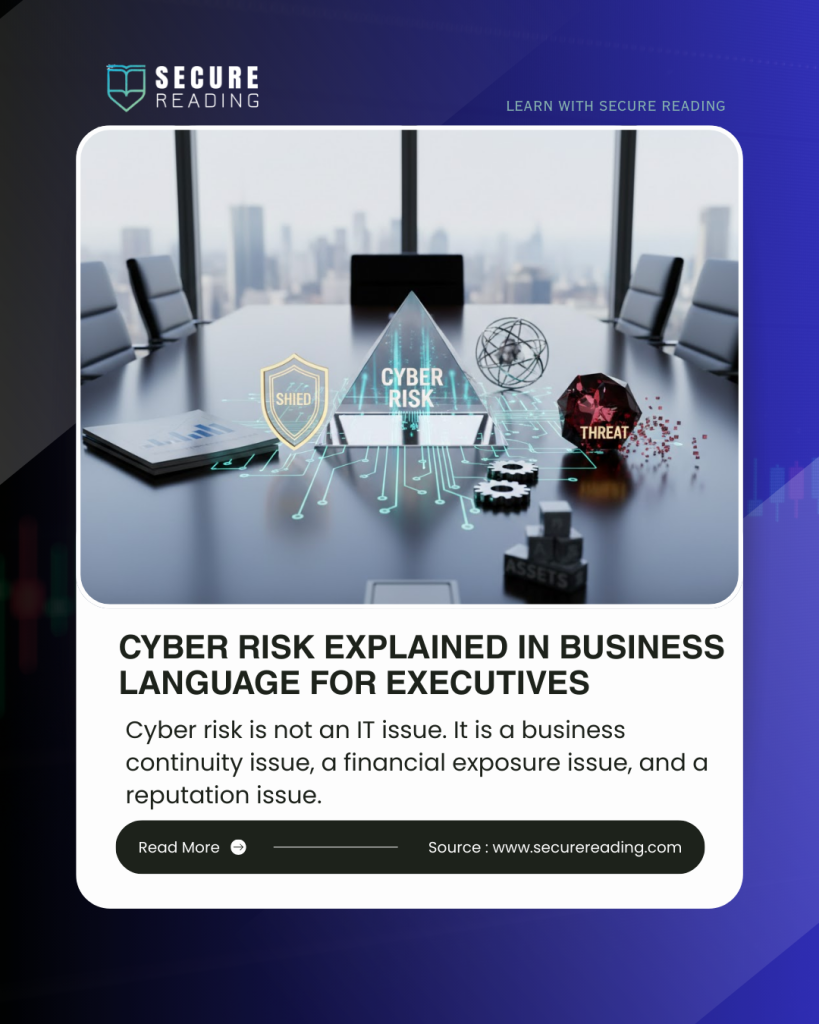
Executives do not need to understand malware code. However, they must understand how cyber risk affects revenue, operations, compliance, and shareholder trust.
Let’s break it down in practical terms.
What Cyber Risk Actually Means
Cyber risk is the possibility that a digital event will disrupt business objectives.
That event may involve:
- Data theft
- Ransomware
- Service outages
- Fraud
- Regulatory penalties
In simple terms, cyber risk equals:
Likelihood of attack × Business impact
If either increases, total risk increases.
Translate Technical Threats Into Business Impact
Instead of saying “we detected a vulnerability,” translate it into executive language:
- Could this stop operations?
- Could this trigger regulatory fines?
- Could this damage customer trust?
- Could this affect revenue?
For example:
A ransomware attack is not just encrypted files.
It is:
- Lost revenue during downtime
- Incident response costs
- Legal expenses
- Customer churn
- Insurance impact
When leadership sees financial and operational impact, cyber risk becomes tangible.
The Four Business Pillars of Cyber Risk
Executives typically care about four areas.
1. Financial Risk
Data breaches create direct costs: recovery, forensics, legal fees, compensation, and regulatory fines.
2. Operational Risk
System outages stop production, logistics, sales platforms, and payment systems.
3. Regulatory and Legal Risk
Frameworks such as General Data Protection Regulation and other compliance mandates impose strict penalties for poor data protection.
4. Reputational Risk
Public trust erodes quickly. Brand damage often lasts longer than the technical recovery.
Why Cyber Risk Is Increasing
Attackers now target identity, cloud platforms, and supply chains. Meanwhile, digital transformation expands the attack surface.
Additionally, geopolitical tensions and ransomware-as-a-service models lower the barrier to entry for criminals.
As a result, every industry faces continuous exposure.
How Executives Should Think About Cyber Investment
Cybersecurity spending should align with risk reduction, not fear.
Leadership should ask:
- Which business processes are mission-critical?
- What would one day of downtime cost?
- Which data assets create regulatory exposure?
- Where is single-point-of-failure risk highest?
Cyber controls should protect what generates revenue and trust.
Board-Level Metrics That Matter
Executives do not need alert volumes. Instead, they need measurable indicators:
- Mean time to detect and respond
- Percentage of critical assets covered by monitoring
- Phishing resistance rate
- Third-party risk exposure
- Backup recovery testing results
These metrics show resilience, not noise.
The Role of the CISO in Business Translation
A strong CISO converts technical complexity into strategic insight.
Instead of saying, “We blocked 20,000 attacks,” say:
“We reduced the probability of operational shutdown by strengthening identity controls.”
Language shapes executive decisions.
Cyber Risk Is Enterprise Risk
Cybersecurity now sits alongside financial, legal, and operational risk in enterprise risk management frameworks.
Forward-thinking organizations integrate cyber reporting into board discussions. They treat it as a strategic priority, not an afterthought.
When executives understand cyber risk in business terms, decisions become proactive instead of reactive.
Final Thought
Cyber risk is not about hackers.
It is about resilience.
Organizations that understand their exposure, quantify impact, and align security to business objectives gain competitive advantage.
Cyber maturity is no longer optional. It is part of modern leadership responsibility.