

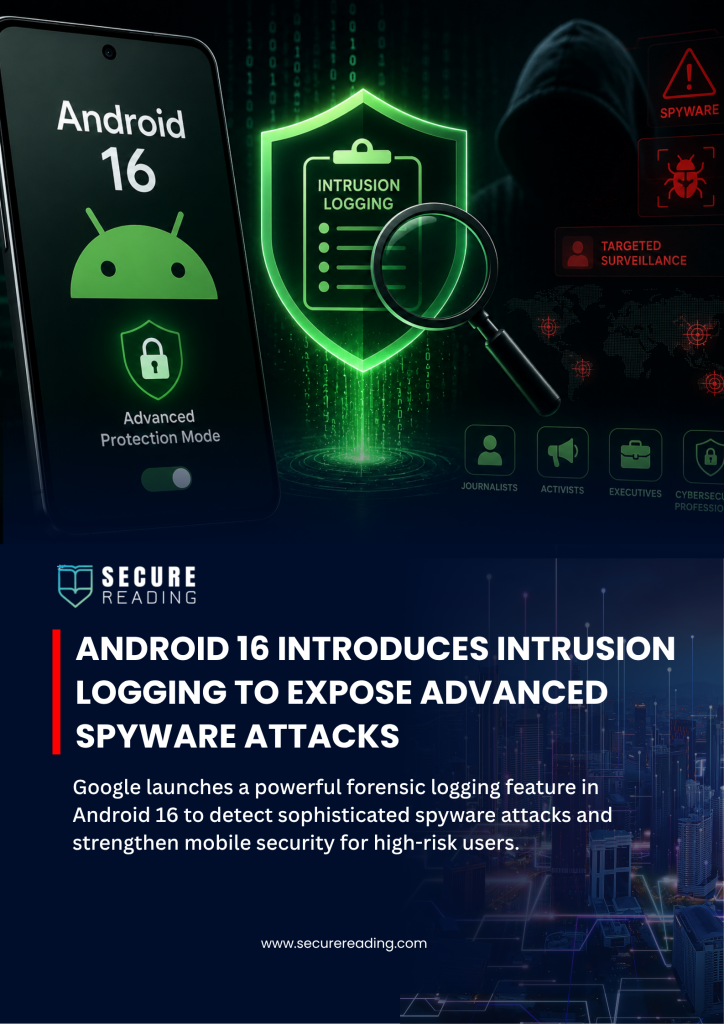
Google launches a powerful forensic logging feature in Android 16 to detect sophisticated spyware attacks and strengthen mobile security for high-risk users.
A New Defense Against Mobile Spyware
Google has introduced a major security feature in Android 16 called Intrusion Logging. This new capability helps users detect and investigate advanced spyware attacks that often stay hidden for long periods.
The feature is part of Android’s Advanced Protection Mode. It mainly supports users who face a higher risk of targeted surveillance, including journalists, activists, executives, and cybersecurity professionals.
These attacks often use sophisticated spyware that leaves very little visible evidence. As a result, security teams struggle to investigate them. Intrusion Logging helps solve that problem.
What Intrusion Logging Records
The feature creates persistent forensic logs that record important device and network activity every day.
It tracks app process starts, app installations, updates, and removals. It also records Wi-Fi activity, Bluetooth connections, DNS lookups, IP connections, USB file transfers, system certificate changes, and device lock and unlock events.
This level of visibility helps trusted security experts review suspicious behavior after a possible compromise.
Privacy Protection Comes First
Google designed this feature with privacy in mind. It stores the logs on secure servers using end-to-end encryption.
Only the device owner can access the logs using their Google Account password and screen lock credentials. Even Google cannot read the stored data.
Because the logs stay outside the device, malware cannot delete, change, or hide them. This creates a stronger forensic trail during investigations involving commercial spyware or state-sponsored surveillance tools.
How Long the Logs Stay Available
Google stores the encrypted logs for 12 months and then removes them automatically.
Users cannot delete the logs before that period ends, even if they turn off the feature or close the account. However, they can download the logs offline if they want to keep them longer for future analysis.
Google also confirmed that system-level logging includes network activity from Chrome Incognito mode. While it does not show exact pages visited, it can still reveal DNS lookups and IP connections to websites.
This detail matters for users handling sensitive work or investigations.
Built with Civil Society Support
Google developed Intrusion Logging with support from Amnesty International and Reporters Without Borders.
This partnership shows how important mobile forensics has become for civil society, digital rights defenders, and investigative journalists.
More Android Security Features Arrive
Google also announced several additional security upgrades for Android devices.
These updates include verified financial calls to stop banking scams, stronger APK malware checks, expanded live threat detection for suspicious app behavior, and better device theft protection.
Android will also improve SMS OTP security, allow carriers to disable 2G by default, and add post-quantum cryptography protections for future threats.
Google is also limiting accessibility service abuse and improving security for AI-related data through AISeal with pKVM.
Why This Matters for CISOs
This update shows a clear shift in Android security strategy. Google is moving beyond prevention and focusing more on detection, investigation, and accountability.
For CISOs and enterprise security leaders, this matters because mobile devices remain one of the weakest security layers in many organizations.
Features like Intrusion Logging improve visibility and help incident response teams act faster when advanced mobile threats appear.
As spyware attacks continue to target executives and high-value individuals, strong mobile forensics is no longer optional. It has become a critical part of modern cybersecurity defense.